
Gen Z and the Future of Democracy : Are Social Media Narratives Replacing Facts?

MP CG Times / Sun, Oct 18, 2026
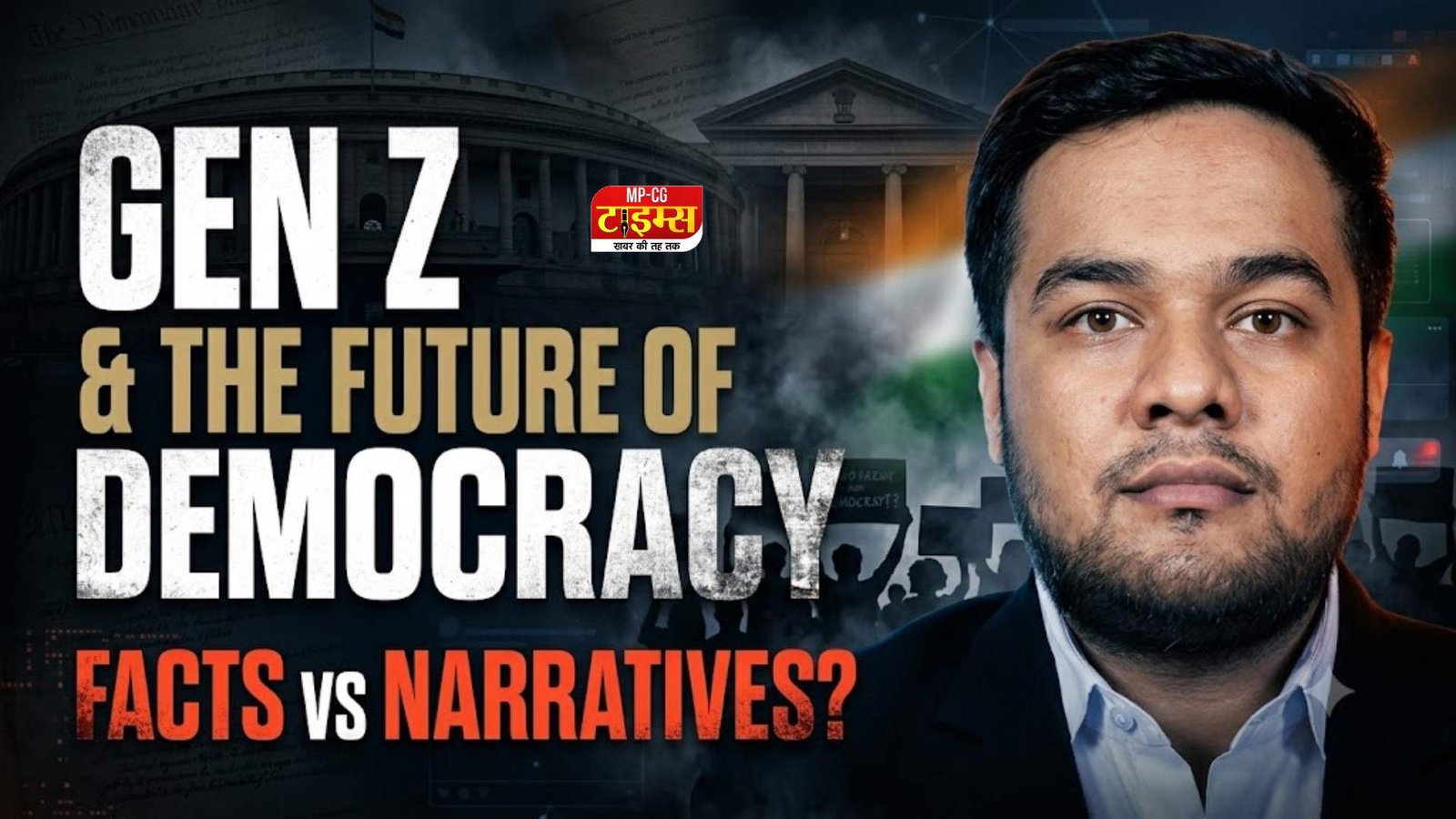
Opinion | Special Article। India's democratic framework is built on constitutional values, freedom of expression and the rule of law. However, the growing influence of social media, political loyalties and public outrage has raised an important question: Are citizens becoming more committed to democratic principles, or are emotions increasingly shaping their understanding of right and wrong?
In a thought-provoking article, Advocate Anurag Gupta of the High Court of Chhattisgarh examines the role of Generation Z, political protests, institutional accountability and responsible citizenship. He argues that questioning authority is essential in a democracy, but so are factual accuracy, constitutional responsibility and respect for the law.
Social Media Virality Does Not Guarantee the Truth
Gen Z is among the most digitally connected generations, with unprecedented access to information, global discussions and opportunities to challenge established institutions. Its technological awareness and willingness to question authority can contribute positively to democratic life.
However, Gupta highlights a growing concern: people sometimes form strong opinions based on short videos, social media posts, WhatsApp forwards and online influencers without examining the underlying facts.
When someone asks for credible evidence or reliable sources, a discussion can quickly turn into personal attacks instead of a reasoned debate.
The central message is simple: a viral video is not necessarily evidence, and a popular opinion is not automatically correct. Citizens must examine the facts before accepting or sharing information.
Millennials and Gen Z: Is There a Generational Divide?
The article explores the differences between older and younger generations through a provocative observation: Millennials may sometimes mistake silence for traditional values, while Gen Z may sometimes mistake rudeness for confidence.
The author presents this as a reflection on social behaviour rather than a judgment against an entire generation.
Respect does not mean unquestioning obedience, just as freedom of expression does not provide the right to humiliate people with opposing views.
According to the article, society must encourage young people to question authority without abandoning civility. At the same time, older generations must be willing to accept legitimate questions instead of treating every challenge to tradition as disrespect.
The real divide, the author suggests, is not necessarily between generations, but between people who defend their views with reason and those who rely on insults.
Protest Is a Democratic Right, but the Law Still Matters
Peaceful protest and freedom of expression are essential elements of Indian democracy. Citizens must be able to question government policies, demand reforms, raise concerns about injustice and mobilise public opinion.
However, Gupta argues that a legitimate grievance does not automatically justify every method used to pursue it.
Peaceful dissent must be distinguished from intimidation. Criticism of public officials is a legitimate democratic activity, while threats and unlawful conduct must be assessed under the applicable law.
The article also stresses that the identity, age or political affiliation of a protester should not determine whether the same conduct is considered acceptable.
A democracy must protect the right to protest while also safeguarding public safety, the rights of other citizens and the lawful functioning of public institutions.
Government and Opposition: Accountability or Endless Political Conflict?
A strong opposition is essential to a functioning democracy. Its role includes scrutinising government decisions, examining public expenditure, exposing wrongdoing and presenting credible alternatives.
Public demonstrations, press conferences and criticism of government policies are legitimate forms of political engagement.
However, the article raises an important question: Is political engagement producing meaningful accountability, or is it becoming a continuous cycle of accusations, outrage and counter-accusations?
Gupta argues that governments must answer legitimate questions, particularly when public concerns arise over security or governance. At the same time, allegations must be assessed using credible information and appropriate scrutiny.
Criticising government policy should not automatically lead to accusations of being anti-national. Equally, national security should not become an excuse for making unsupported political allegations.
The article calls for a balanced approach in which neither the government nor the opposition is exempt from scrutiny.
Elections and the Judiciary Must Remain Above Political Loyalty
Election-related controversies, including concerns about voter lists, counting procedures and the impartiality of election authorities, deserve serious examination when supported by specific evidence.
The article makes an important distinction: questioning an electoral process is legitimate, but declaring an election illegitimate merely because a party has lost is not a substitute for evidence.
A political victory should not place the electoral process beyond scrutiny. Similarly, an electoral defeat should not automatically be treated as proof of fraud.
The author also discusses the judiciary, arguing that court decisions can be examined and challenged through established legal procedures. However, disagreement with a judgment does not, by itself, establish that the judiciary is biased or compromised.
Democratic institutions require accountability and transparency, but their credibility should be assessed through evidence rather than political convenience.
Social Media Activism: A Movement for Change or a Contest for Visibility?
Digital platforms have transformed political mobilisation. A single post can bring attention to an injustice that might otherwise remain overlooked. Social media also enables citizens to organise, exchange ideas and question powerful institutions.
However, these platforms often reward dramatic confrontations, provocative language and emotionally charged content.
This creates a difficult question: Are movements being built around clear objectives and practical solutions, or is success increasingly measured through views, followers and trending hashtags?
Gupta does not suggest that every protest is driven by publicity. Genuine activists have made important contributions to public life, and their efforts deserve recognition.
Instead, the article argues that the seriousness of a movement should be assessed through the clarity of its demands, the credibility of its evidence, the conduct of its participants and its willingness to engage with lawful processes.
A protest should not be judged solely by its online popularity or the political identity of its participants.
The Rule of Law Must Apply Equally to Everyone
One of the article's central arguments is that the law must be applied consistently, regardless of political affiliation, age, ideology or public popularity.
The same conduct should not be condemned when committed by political opponents and defended when carried out by political allies.
At the same time, law enforcement agencies must act fairly, proportionately and in accordance with due process.
The mere presence of a protest does not establish that an offence has occurred. Equally, describing an activity as a protest does not automatically provide legal protection for every action taken during it.
The article refers to Section 221 of the Bharatiya Nyaya Sanhita, 2023, and Section 186 of the Indian Penal Code, 1860, while emphasising the importance of legal precision. The applicable provision in a particular case depends on the facts, the date of the conduct and the relevant legal framework.
The broader message is that the rule of law cannot be treated as a political slogan to be invoked selectively against others.
Five Questions Every Responsible Citizen Should Ask
The article proposes five questions that citizens should consider before participating in public debate:
Before sharing information: Have I verified the facts, or am I simply forwarding something because it provokes an emotional reaction?
Before joining a protest: Do I understand the demand, the supporting evidence and the lawful options available?
Before making an allegation: Can I substantiate my claim with credible material?
Before defending a political party: Would I apply the same standards if the opposing party were in power?
Before criticising an institution: Am I questioning a specific action based on evidence, or rejecting the institution because I dislike the outcome?
These questions are not directed at Gen Z alone. They apply equally to political leaders, activists, public commentators and every citizen who participates in democratic debate.
Conclusion: Democracy Requires More Than the Freedom to Disagree
The central argument of Advocate Anurag Gupta's article is that democracy cannot be strengthened by silencing protesters, blindly trusting the government or treating every institution as beyond criticism.
A healthy democracy requires an accountable government, a constructive opposition, independent institutions and citizens who verify information before accepting or spreading it.
Peaceful protest must remain protected, and public institutions must remain open to scrutiny. However, political loyalty should never become a substitute for constitutional principles.
The article leaves readers with a fundamental question: Is India nurturing citizens who can bring change through reason and responsibility, or are people increasingly mistaking outrage for awareness and noise for meaningful change?
The strength of a democracy depends not simply on how many people speak, but on how responsibly they think, question, listen and act.

Author: Advocate Anurag Gupta, High Court of Chhattisgarh
Editorial note: This article is based on the author's supplied opinion piece. The arguments and observations presented are attributed to the author and should not be interpreted as independently verified reporting of a specific news event.
Tags :
विज्ञापन
विज्ञापन
जरूरी खबरें



विज्ञापन